Spring/Summer 7-on-7 Football: How Coaches Can Build Quarterbacks, Receivers, DBs and Team Chemistry
Spring/Summer 7-on-7 Football: A Coach’s Guide to Making It Count
Spring and summer 7-on-7 football has become one of the most useful off-season tools available to high school football coaches. It is not real football in the full sense. There are no offensive linemen, no pass rush, no run game, no tackling and no true physical line-of-scrimmage battle. But when it is coached correctly, 7-on-7 can become one of the best ways to develop quarterbacks, wide receivers, running backs, tight ends, linebackers, defensive backs, communication, coverage recognition and offensive timing.
The key phrase is coached correctly.
Too many programs treat 7-on-7 like a summer tournament circuit only. They chase trophies, matching shirts and highlight clips. That may create excitement, but it does not always create better football players. The best programs use spring and summer 7-on-7 as a teaching laboratory. They use it to build timing in the passing game, train quarterbacks to identify coverage, teach receivers how to attack leverage, develop defensive backs in man and zone technique, and give young players live reps before the pressure of Friday night arrives.
For high school football coaches, 7-on-7 should not be viewed as a separate sport. It should be viewed as an extension of your football program.
If Your Program Is Not Involved in 7-on-7, Here Is How to Start
A coach does not need a massive budget or national tournament schedule to benefit from 7-on-7 football. In fact, many programs get more value from simple local work than from expensive travel events.
Start with your own roster. Put together your quarterbacks, receivers, tight ends, running backs, linebackers and defensive backs. Begin with one or two nights per week during spring or early summer. Keep it simple. Work routes on air, coverage drops, individual technique, then controlled competitive periods.
The next step is finding nearby schools that want the same thing. Call three or four local coaches and organize a weekly 7-on-7 passing league. Keep the structure clean. Rotate opponents, play controlled series, emphasize teaching over arguing, and make sure every coach understands the purpose: development.
You can also host a small school-based 7-on-7 day. It does not need to be complicated. Four teams, two fields, short games, certified officials if possible, and a clear sportsmanship expectation. The value comes from reps, not the trophy.
For younger programs, 7-on-7 can also be done internally. Split your own roster into two teams. Let older players lead younger players. Give backup quarterbacks real reps. Put sophomore defensive backs against varsity receivers. Use the summer to build depth instead of waiting until August to find out who can play.
What 7-on-7 Should Develop
A good 7-on-7 program should help your team improve in five major areas.
First, it should develop quarterback decision-making. The quarterback should learn how to identify coverage, understand safety rotation, recognize leverage, throw with anticipation and protect the football. A quarterback who waits until a receiver is wide open in 7-on-7 will struggle when pass rush is added in the fall.
Second, it should improve receiver route discipline. Receivers must learn landmarks, spacing, stems, releases, break points and how to adjust routes versus different coverages. Summer is the time to clean up sloppy route running.
Third, it should sharpen defensive communication. Linebackers and defensive backs must learn to talk. They should identify formations, communicate strength, call out route combinations, pass off receivers and understand where their help is.
Fourth, it should build team chemistry. A passing game is built on trust. The quarterback must trust that the receiver will be at the right depth. The receiver must trust that the ball will arrive on time. Defensive backs must trust each other in coverage.
Finally, it should create competitive confidence. Young players need live reps. They need to make mistakes, correct them and compete again. Summer 7-on-7 gives coaches a chance to evaluate players in space before the full-contact season begins.
Chalkboard Diagram 1: Basic 2x2 Spacing Concept
This is one of the best starting points for 7-on-7 work because it teaches spacing, timing and quarterback progression.
                 FS

        CB                 CB

             OLB     MLB     OLB


X ------------------          ------------------ Z
        5-yard hitch            5-yard hitch

H ---------> Arrow      Y ---------> Arrow

                 QB
                 RB
Coaching Points
The outside receivers run five-yard hitches. The inside receivers work quick arrows to the flat. The quarterback can read the flat defender. If the outside linebacker widens with the arrow, throw the hitch. If the outside linebacker sits inside, throw the arrow.
This is simple, but it teaches an important football lesson: do not just throw routes, throw defenders. The quarterback must learn to make the defender wrong.
Quarterback Training Tips for 7-on-7
The quarterback should never treat 7-on-7 like pitch and catch. Every rep should have a purpose. Before the snap, he should identify the shell, count the safeties, locate the corners, understand linebacker depth and know where his first answer is.
A good quarterback progression during 7-on-7 should include:
Pre-snap: Identify coverage shell, leverage and possible pressure look.
Post-snap: Confirm rotation and find the conflict defender.
Throw: Deliver the ball on time, not late.
Finish: Learn from the rep immediately.
Coaches should demand that quarterbacks use their feet. Even without a pass rush, the quarterback must take realistic drops. If your offense uses three-step, quick-game footwork, then the ball should come out on rhythm. If your offense uses five-step concepts, the quarterback must hitch with purpose.
Do not let quarterbacks drift backward, pat the ball or wait too long. Those bad habits get exposed when the pads go on.
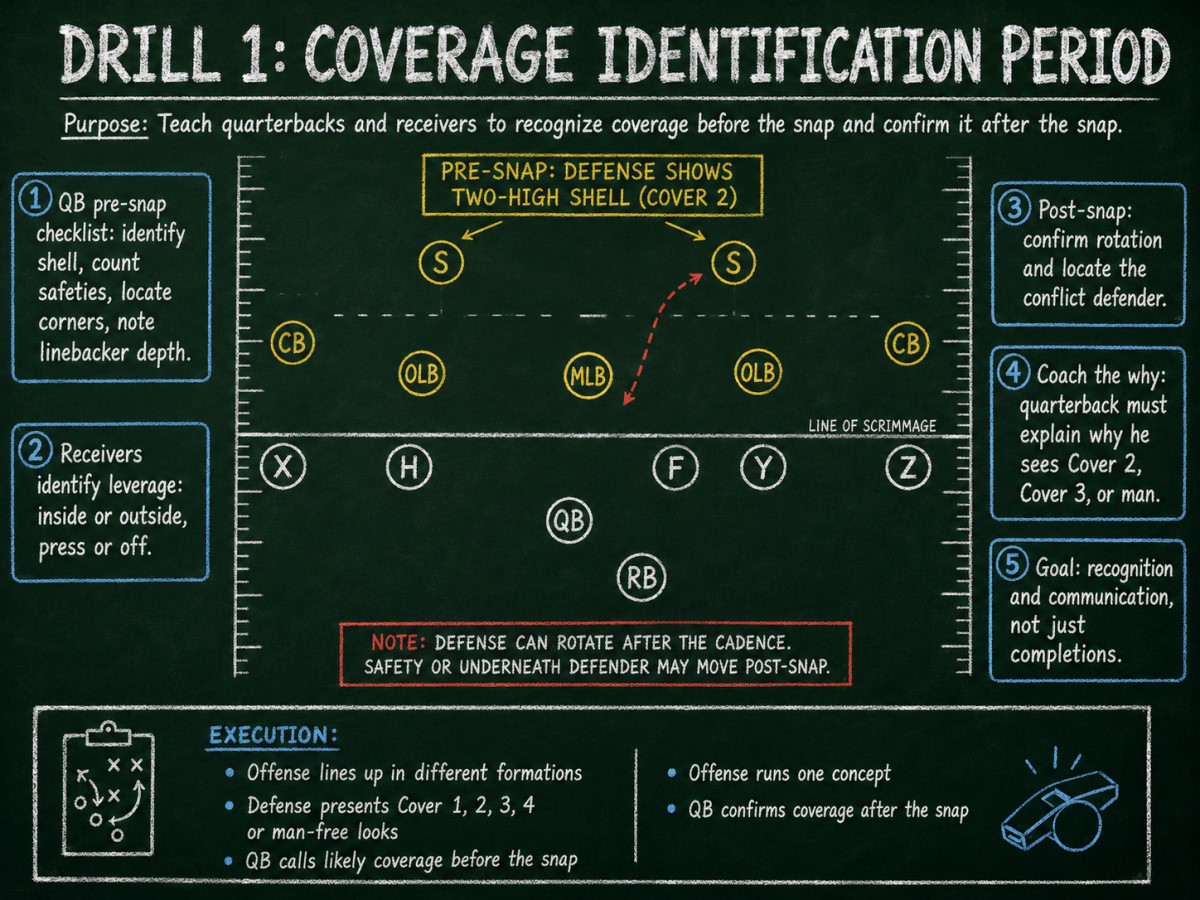
Drill 1: Coverage Identification Period
Purpose
Teach quarterbacks and receivers to recognize coverage before running a full competitive period.
Setup
Line up the offense in different formations. The defense aligns in Cover 1, Cover 2, Cover 3, Cover 4 or man-free looks. The quarterback must identify the coverage shell before the snap.
Execution
The quarterback calls out the likely coverage. Receivers identify corner leverage and safety alignment. Defense rotates after the cadence. The offense runs one concept and the quarterback must confirm coverage after the snap.
Coaching Points
Do not allow guessing. Make the quarterback explain what he sees. Ask him why he thinks it is Cover 2, Cover 3 or man coverage. The goal is not just to complete passes. The goal is to build a quarterback who understands defensive structure.
Chalkboard Diagram 2: 3x1 Stick Concept
The stick concept is a great 7-on-7 concept because it teaches spacing, leverage and quick decision-making.
                 FS

        CB                 CB

             OLB     MLB     OLB


X ---------------- Slant

H ---------> Arrow

Y ------ Sit / Stick

Z ---------------- Go

                 QB
Quarterback Read
The quarterback reads the flat defender. If the flat defender widens with the arrow, throw the stick. If the flat defender sits inside, throw the arrow. If the defense overplays the quick game, the outside go route can become an alert throw.
Receiver Coaching Points
The stick route must settle in open grass. The receiver cannot drift. The arrow route must get width quickly. The outside receiver must push vertical and clear space. Every route has a job, even if it does not get the ball.
Receiver Training Ideas for Spring and Summer
Wide receivers often love 7-on-7 because they get targets and space, but coaches must make sure they are developing complete players. A receiver who catches a lot of balls in shorts but cannot run disciplined routes will not help the offense in the fall.
Focus on releases, stems, route depth, body control and finishing the catch. Make receivers understand coverage. A route is not just a line on paper. It changes based on leverage.
Against outside leverage, the receiver may need to attack the defender’s blind spot. Against inside leverage, he may need to widen and create space. Against zone coverage, he must understand where to sit. Against man coverage, he must win with release, tempo and separation.
Summer is also a great time to train scramble rules. Quarterbacks will get moved off the spot during the season. Receivers need to know how to uncover when the play breaks down.
Drill 2: Route Stem and Break Drill
Purpose
Teach receivers to sell vertical, attack leverage and break cleanly.
Setup
Place cones at 5, 10 and 12 yards. Receivers work different routes from both sides of the formation.
Sideline

WR  -------------------- 5 yd cone
    -------------------- 10 yd cone
    -------------------- 12 yd cone

CB alignment changes each rep:
Inside leverage / Outside leverage / Press / Off
Execution
The coach gives the receiver a route and a defensive leverage look. The receiver must stem the defender properly before breaking. The quarterback throws on time.
Coaching Points
Receivers should not round cuts. They should not drift. They should not give away the route with lazy tempo. Every route should look vertical until it is not.
Defensive 7-on-7 Coaching: Do Not Waste the Summer
7-on-7 is often talked about as an offensive passing game tool, but it may be even more valuable for defensive development. Linebackers and defensive backs get repeated reps reading formations, communicating coverage, matching routes and playing the ball in space.
Defensive coaches should not simply call coverage and hope players figure it out. Teach the details.
Where is the help?
Who has the flat?
Who carries vertical?
Who relates to number two?
Who cuts the crosser?
Who owns the middle?
Who communicates motion?
The best defensive 7-on-7 teams are not always the most athletic. They are usually the teams that communicate the best.
Chalkboard Diagram 3: Defensive Route Match Drill
This drill teaches defenders to communicate against a common 3x1 route distribution.
              FS

CB                         CB

       OLB       MLB       OLB


X -------- Go

H -------- Out

Y -------- Seam

Z -------- Dig

              QB
Defensive Coaching Points
The defense must communicate the strength, identify the three-receiver surface and handle vertical threats. The linebacker must relate to the inside route. The safety must understand whether he is helping on the seam, robbing the dig or staying deep depending on the coverage call.
Do not just coach the result. Coach the eyes. Bad eyes create bad coverage.
Drill 3: Red Zone 7-on-7 Period
Purpose
Teach offensive spacing and defensive leverage in the red zone, where space is reduced and every window is tighter.
Setup
Place the ball on the 20-yard line, then the 10-yard line, then the 5-yard line. Give the offense four downs to score.
Goal Line
================================================

CB          LB       LB       LB          CB
          S                       S

X             H        QB        Y             Z
Execution
Offense must call red zone concepts. Defense must communicate coverage and force tight-window throws. Rotate quarterbacks and defensive backs often.
Coaching Points
In the red zone, receivers must be precise. There is no room to drift. Quarterbacks must throw with anticipation. Defenders must understand that the back line of the end zone is an extra defender.
This is a great period for fade-stop, slant-flat, sprint-out, rub concepts, high-low reads and tight-window throws.
7-on-7 Practice Plan Example
A simple summer 7-on-7 workout can be done in 75 minutes.
0:00 - 0:10   Dynamic warm-up and ball skills
0:10 - 0:20   Quarterback/receiver routes on air
0:20 - 0:30   Defensive coverage drops and communication
0:30 - 0:45   Concept teaching period
0:45 - 1:00   Controlled 7-on-7 situational work
1:00 - 1:10   Red zone period
1:10 - 1:15   Leadership huddle and player feedback
The final five minutes matter. Ask players what they saw. Let the quarterback explain a read. Let a defensive back explain a coverage bust. Let a receiver talk through a route adjustment. That is how 7-on-7 becomes more than reps. It becomes football education.
Common 7-on-7 Mistakes Coaches Should Avoid
The first mistake is chasing wins instead of development. Winning is great, but summer 7-on-7 should prepare your team for the fall. If your starting quarterback takes every rep and your young players stand around, you are wasting valuable time.
The second mistake is running concepts that are not part of your offense. It is tempting to install every passing concept you see online, but summer work should support your actual system. Run what you believe in. Build timing in the concepts you plan to call on Friday night.
The third mistake is letting quarterbacks hold the ball too long. Without a pass rush, quarterbacks can develop unrealistic habits. Use a clock. Give them 3.0 seconds or less. Make the ball come out.
The fourth mistake is ignoring defense. If your defensive players are just “giving the offense a look,” you are missing half the value. Coach coverage. Coach leverage. Coach communication.
The fifth mistake is forgetting leadership. Summer football gives coaches a chance to see who communicates, who competes, who responds to correction and who brings energy when no crowd is watching.
Best 7-on-7 Concepts to Install Early
For most high school football programs, the best early 7-on-7 concepts are not complicated. They are concepts that teach quarterback reads and route discipline.
Good starting concepts include:
Spacing for quick-game timing.
Stick for reading the flat defender.
Slant-flat for leverage throws.
Hitch-seam for attacking underneath defenders.
Mesh for man coverage answers.
Flood for high-low reads.
Four verticals for coverage identification.
Smash for corner/safety conflict reads.
The goal is not to have the biggest passing menu. The goal is to get great at the concepts that fit your players and your offensive identity.
Chalkboard Diagram 4: Smash Concept
                 FS

        CB                 CB

             OLB     MLB     OLB


X ------ Hitch

H ------ Corner

Y ------ Seam / Clear

Z ------ Hitch

                 QB
Quarterback Read
The quarterback reads the cornerback and safety relationship. If the corner squats on the hitch and the safety stays inside, the corner route can open. If the corner sinks under the corner route, throw the hitch.
Coaching Points
The corner route must create width and depth. The hitch cannot drift. The quarterback must throw on rhythm and understand where the safety is located.
How 7-on-7 Helps the Full Team
Even though 7-on-7 does not include linemen, it can still benefit the entire program when handled correctly. Offensive linemen can train separately during 7-on-7 periods with pass sets, footwork, hand placement and communication. Defensive linemen can work get-offs, pass rush lanes, hand fighting and pursuit angles.
This allows the whole team to train at the same time. While the skill players compete in 7-on-7, the bigs can get better in the trenches. Then the team can come together for conditioning, leadership work or film review.
A complete summer program should never leave linemen standing around. Build a parallel plan for them and make it just as important.
Final Thought: Make 7-on-7 Football Serve Your Program
Spring and summer 7-on-7 football can be a powerful development tool for high school football coaches. It can build quarterbacks, sharpen route running, improve defensive communication, create competitive reps and bring a team together before the season begins.
But it must serve the program.
Do not let 7-on-7 become a separate identity. Do not let it become backyard football. Do not let it become a highlight contest. Use it to teach your passing game, train your coverage system, develop young players and build leadership.
The teams that get the most out of 7-on-7 are not always the teams with the flashiest uniforms or the most tournament wins. They are the teams that use every rep with purpose.
Spring and summer are not just for throwing the football around.
They are for building timing.
They are for building confidence.
They are for building communication.
They are for building players.
And when fall arrives, those summer reps will show up on Friday night.